
Implications of a Fast Analogy Engine
For Ontology Design and Use
John F. Sowa
VivoMind LLC
Mitre Technical Exchange Meeting
12 June 2003

Cyc Review
Two-day DARPA-sponsored review of Cyc on June 10th & 11th with about two dozen AI experts.
Consensus:
- Cyc is a unique and valuable resource:
Since 1984, 650 person years and $65 million to define and axiomatize about 600,000 concept types.
- Support for Cyc should be continued.
- Cyc should be freely available for research purposes.
- Many questions about the relationship of Cyc to other R & D efforts.
Lexical Resources
Developers of WordNet (George Miller) and FrameNet (Chuck Fillmore) were also present.
Consensus:
- Lexical resources are complementary to Cyc.
- Extremely valuable for natural language projects.
- Desirable to integrate contributions from various sources.
- Integration would require relatively modest funding.
- Word senses (synsets) can be linked to the concept types of Cyc and other axiomatized ontologies.
- Further questions to be explored.
Common Logic (CL)
Abstract syntax and model theory for logic-based languages.
Currently supported: KIF, conceptual graphs, and OWL.
Other notations can be supported: Z, UML Object Constraint Language, and traditional predicate calculus.
Lenat agreed
- CycL is very close in expressive power to CL.
- Defining CycL in terms of CL abstract syntax is important for knowledge interchange.
- Doing so would give CycL a model-theoretic semantics.
Feigenbaum's Question #1
Ed Feigenbaum asked a question:
- Lenat had claimed that when the KB reached a critical size, new knowledge could be added much faster.
- Recently, the size of the KB has increased significantly.
- Has Cyc now reached a critical mass that would support an exponential increase in size?
Fritz Lehmann's response: The major reason for the recent
increase is a managerial decision by Lenat.
Feigenbaum's Question #2
Feigenbaum asked another question:
- In 1961, I. J. Good made a prediction:
It is more probable than not that, within the twentieth century, an ultraintelligent machine will be built and that it will be the last invention that man need make.
- Why hasn't Good's prediction come to pass?
- Is there some missing ingredient that the AI community hasn't discovered?
- What is it? Could it be added to Cyc?
Sowa's Answer
The missing ingredient is analogical reasoning:
- All human thinking is based on analogies.
- All aspects of logic — induction, deduction, and abduction — are highly disciplined, special cases of analogy.
- A high-speed analogical reasoner would be more flexible than Cyc.
- And it could call Cyc as a subroutine.
This answer generated more squabbles than consensus.
Intellitex
- NL processor developed by VivoMind LLC.
- Lightweight syntax with heavy semantics.
- Based on conceptual graphs (CGs) — a graphical version of logic.
- Uses analogies as its primary reasoning method.
- VivoMind Analogy Engine (VAE) takes (N log N) time to find analogies — where N is the number of nodes in the knowledge base.
- Older algorithms take N3 time.
VivoMind Analogy Engine
Three methods of analogy:
- Matching labels:
- Compare type labels on conceptual graphs.
- Matching subgraphs:
- Compare subgraphs independent of labels.
- Matching transformations:
- Transform subgraphs.
Methods #1 and #2 take (N log N) time.
Method #3 takes polynomial time (analogies of analogies).
Analogy of Cat to Car
| Cat | Car |
|---|---|
| head | hood |
| eye | headlight |
| cornea | glass plate |
| mouth | fuel cap |
| stomach | fuel tank |
| bowel | combustion chamber |
| anus | exhaust pipe |
| skeleton | chassis |
| heart | engine |
| paw | wheel |
| fur | paint |
VAE used methods #1 and #2.
Source data from WordNet mapped to CGs.
Matching Labels
Corresponding concepts have similar functions:
- Fur and paint are outer coverings.
- Heart and engine are internal parts with a regular beat.
- Skeleton and chassis are structures for attaching parts.
- Paw and wheel support the body, and there are four of each.
Matching Subgraphs
A pair of isomorphic subgraphs:
- Cat: head → eyes → cornea.
- Car: hood → headlights → glass plate.
Approximate match (missing esophagus and muffler):
- Cat: mouth → stomach → bowel → anus.
- Car: fuel cap → fuel tank → combustion chamber → exhaust pipe.
Relating Different Representations
Method #3 for relating data structures that represent equivalent information.

- A structure described in different ways:
- English description: "A red pyramid A, a green pyramid B, and a yellow pyramid C support a blue block D, which supports an orange pyramid E."
- A relational database would use tables.
- But many different options for chosing tables, rows and columns, and labels for the columns.
Representation in a Relational DB

CG Derived from Relational DB

CG Derived from English
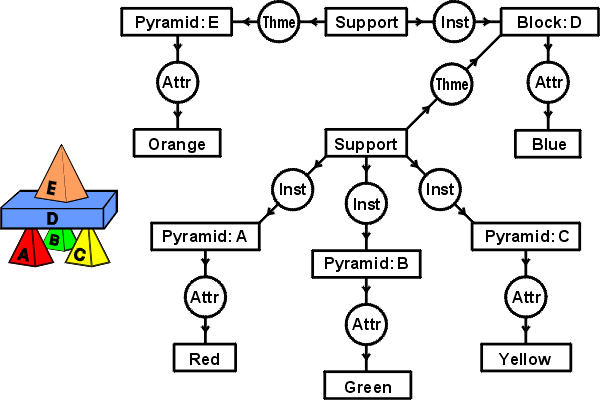
"A red pyramid A, a green pyramid B, and a yellow pyramid C support a blue block D, which supports an orange pyramid E."
The Two CGs Look Very Different
- CG from RDB has 15 concept nodes and 8 relation nodes.
- CG from English has 12 concept nodes and 11 relation nodes.
- No label on any node in the first graph is identical to any label on any node in the second graph.
- But there are some structural similarities.
- VAE uses method #3 to find them.
Transformations Found by VAE

Top transformation applied to 5 subgraphs.
Bottom one applied to 3 subgraphs.
One application could be due to chance, but 3 or 5 contribute
strong evidence for the mapping.
Legacy Re-engineering
An earlier version of Intellitex was applied to three languages — English, COBOL, and JCL:
- 1.5 million lines of COBOL.
- Several hundred JCL scripts.
- 100 megabytes of English documentation — text files, e-mails, Lotus Notes, HTML, and transcriptions of oral communications.
Same Parser for Three Languages
- English used canonical graphs derived from WordNet and task-oriented graphs for the application.
- COBOL and JCL did not require the WordNet graphs, but they used the same task-oriented graphs.
- Results represented in conceptual graphs independent of the source language.
- Translated to diagrams with English text:
Glossary, data dictionary, data flow diagrams, process architecture diagrams, system context diagrams.
Results
Job finished in 8 weeks by two programmers, Arun Majumdar and André LeClerc.
- Four weeks for customization:
- Design and logistics.
- Additional programming for I/O formats.
- Three weeks to run Intellitex + VAE + extensions:
- 24 hours a day on a 750 MHz Pentium III.
- VAE handled matches with strong evidence.
- Matches with weak evidence were confirmed or corrected by Majumdar and LeClerc.
- One week to produce a CD-ROM with integrated views of the results:
Glossary, data dictionary, data flow diagrams, process architecture, system context diagrams.
Supporting Multiple Ontologies
- Cyc supports microtheories, which are subontologies that may be inconsistent with one another.
- Example: microtheories about vampires or Greek mythology.
- Cyc currently has 6,000 microtheories.
- Cyc can create new microtheories dynamically to represent modalities or some agent's knowledge and belief.
- But there is a need for different microtheories even at the upper levels of the ontology.
Example from Cyc
A sample story used by the Cyc ontologists:
Jim, a car dealer, saw a tornado approaching the lot where all his cars were located. Shortly thereafter, the tornado swept through the lot and destroyed all his cars.
Implications of the Cyc ontology:
- If a tornado approaches, it is an object.
- If a tornado destroys something, it is an event.
- But objects and events are disjoint.
- Therefore, there must be two distinct entities: TornadoAsObject and TornadoAsEvent.
Precision and Vagueness
Precision is sometimes bad:
- Essential for computability and logical deduction.
- But highly inflexible: an advantage in some cases, but a disadvantage in other cases.
- A precise ontology may force undesirable choices.
Vagueness is sometimes good:
- Inevitable starting point for planning, design, research, and any kind of sincere negotiation.
- Some things — such as tornadoes, glaciers, and clouds — may be both objects and events.
Cyc Intermediate Language (I-CycL)
- I-CycL uses the same syntax and logical operators as CycL.
- But I-CycL uses concept types that map directly to the words of natural languages.
- The concept type Tornado, for example, could be used in I-CycL.
- But in the mapping from I-CycL to CycL, the constraints imposed by the Cyc ontology would replace Tornado with either TornadoAsObject or TornadoAsEvent.
Mapping Language to Logic
The I-CycL approach has also been used with other logic-based languages, including conceptual graphs:
- The first stage of mapping language to logic uses labels taken from lexical resources, such as WordNet and FrameNet.
- Usually, there is a one-to-many mapping from the lexical labels to the names of the concept types and relations in the ontology.
- The selection of specific concept types and relations depends on constraints derived from axioms and definitions in the ontology.
Conclusions
The analogy engine should be the primary controller:
- Most human activities are guided by analogies.
- People can do precise deduction, but only when they "stop to think."
- VAE has been successfully used as an agent's primary controller and evaluator.
- A system such as Cyc can be used as an assistant for planning.
- But the main use for deduction is to provide more data for the analogy engine.
References
Paper on analogical reasoning by Sowa and Majumdar:
http://www.jfsowa.com/pubs/analog.htm
Cyc web sites:
http://www.cyc.com/
WordNet web site:
http://www.cogsci.princeton.edu/~wn/
FrameNet web site:
http://www.icsi.berkeley.edu/~framenet/
Paper on Laws, Facts, and Contexts:
http://www.jfsowa.com/pubs/laws.htm
Peirce's tutorial on existential graphs, with commentary by Sowa:
http://www.jfsowa.com/peirce/ms514.htm